Guides· 5 min
Low-Volume PCB Assembly in China: MOQ, Lead Time & Cost
No MOQ doesn't always mean no minimum. What low-volume PCB assembly in China really involves: hidden part minimums, real lead times and small-batch cost.

Tech sharing from our engineers, industry news and life at the Onlitex factory.
No MOQ doesn't always mean no minimum. What low-volume PCB assembly in China really involves: hidden part minimums, real lead times and small-batch cost.
From DFM and BOM choices to panelization and test strategy: eight practical ways to reduce PCB assembly cost without putting reliability at risk.
Turnkey, consigned or partial turnkey PCB assembly? Compare cost, lead time, risk and control, and see which sourcing model fits your project best.
Certifications, MOQ, sourcing, testing, IP protection and lead time — ten questions that help you choose the right PCB assembly partner in China.
Surface-mount or through-hole? Compare cost, reliability, density and production speed to choose the right PCB assembly method for your product.
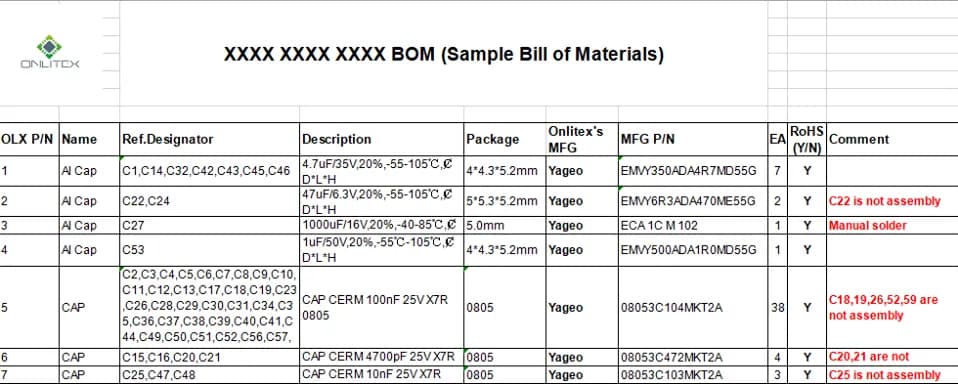
Gerber, BOM, pick-and-place, STP and test specs — the exact files a PCB assembly manufacturer needs to give you an accurate quote in 24–48 hours.

To protect employee health and safety and prepare for unexpected accidents, Onlitex has equipped every workshop with an emergency medical kit.

Sinopec has produced China's first domestically made high-performance liquid rubber for high-frequency copper clad laminate, a key material for 5G circuit boards.

5G, AI, cloud computing and big data are pushing demand for high-speed, low-loss PCBs — and manufacturers are racing to win the high-end market.

How PCBs replaced point-to-point wiring, why flexible PCBs are in demand, and the main types of FPC: single-layer, double-sided and multilayer.

In a turbulent supply chain, suppliers help PCB makers through hard times, power their move to the high end and quietly support their everyday success.

Advanced packaging and chiplets will flip ABF carrier boards from 5% oversupply in 2023 to shortages of 5% in 2024 and 8% in 2025, analysts say.