What a ball grid array (BGA) package is, how PBGA, CBGA and TBGA packages differ, and the main advantages and drawbacks of BGA components.
 Onlitex Engineering Team3 min read
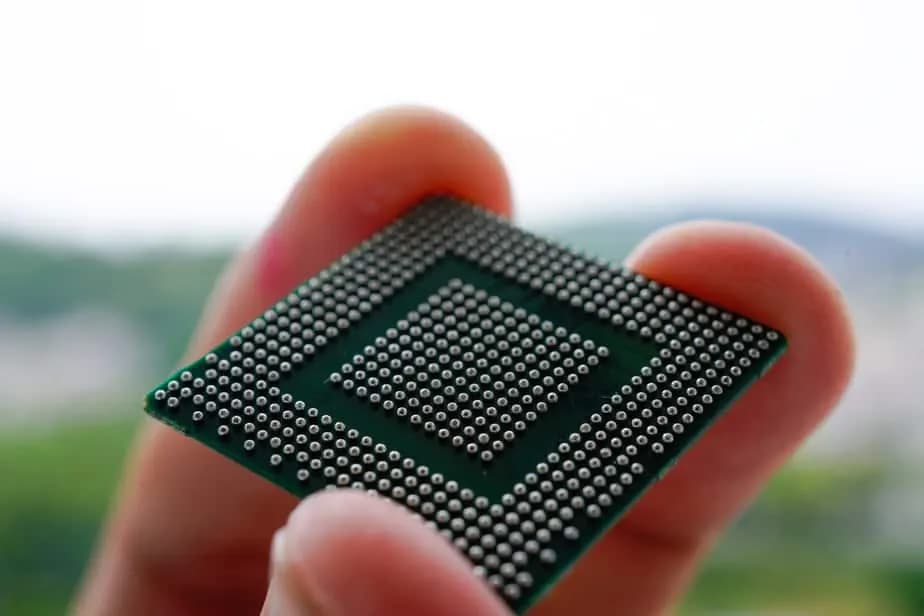
A ball grid array (BGA) is a type of surface-mount package used for integrated circuits. BGA packages are used to permanently mount devices such as microprocessors. A BGA can provide more interconnection pins than a dual in-line or flat package, and each pin is provided with a solder ball. All connections are distributed in a uniform surface grid, or matrix, on the component, so the whole bottom surface of the device can be used instead of just the perimeter.
On average, the leads are also shorter than with a perimeter-only package, which gives better performance at high speeds. Soldering BGA devices requires precise control and is usually done by automated processes. BGA devices are not suitable for socket mounting.
Types of BGA packages
According to the substrate used, BGA packages can be divided into three types:
- PBGA (plastic ball grid array)
- CBGA (ceramic ball grid array)
- TBGA (tape ball grid array)
PBGA (plastic ball grid array)
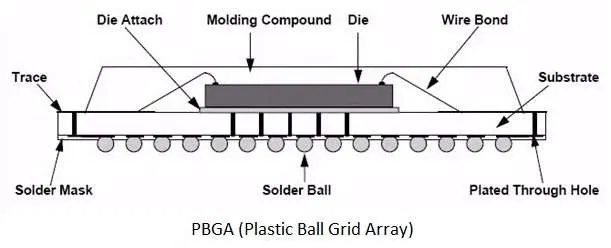
The plastic ball grid array has received the most attention and the widest application. It uses BT (bismaleimide triazine) resin as the substrate material, together with OMPAC (over-molded pad array carrier) or GTPAC (glob-top pad array carrier) sealing technology, and its reliability has been verified to JEDEC Level 3. PBGA packages with 200 to 500 solder balls are widely used and work best on double-sided PCBs.
CBGA (ceramic ball grid array)
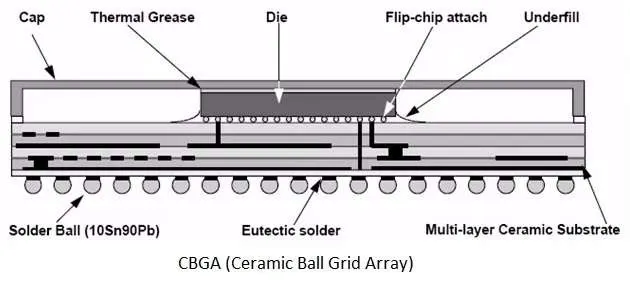
As the name suggests, CBGA packages use ceramic as the substrate material, with high-melting-point solder balls (tin-to-lead ratio of 10:90). The internal chip uses C4 (controlled collapse chip connection) for a reliable connection between the BGA and the PCB. This type of connection offers excellent thermal conductivity and electrical performance. CBGA also has excellent reliability, but at a high cost, so CBGA packages are more suitable for automotive applications or high-performance chips.
TBGA (tape ball grid array)
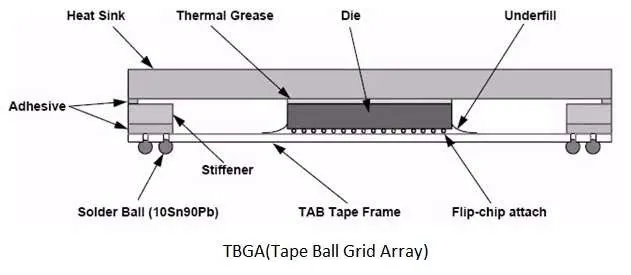
The tape ball grid array effectively reduces package thickness and provides excellent electrical performance. Excellent heat dissipation can also be achieved when a heat sink and a face-down chip design are used, so TBGA suits high-performance products with thin packages. For face-down chips, flip-chip technology should be used, while for face-up chips, wire bonding should be used. Generally speaking, TBGA costs more than PBGA.
Advantages and disadvantages of BGA
Advantages of BGA
- Soldering high-density packages is less problematic, because solder is already applied to the package in the right proportion.
- Low thermal resistance between the package and the PCB helps prevent the chip from overheating.
- BGA is used in security-sensitive applications because it prevents direct physical access to the chip's connections.
- The distance between the PCB and the package is very short, giving low inductance and better performance than leaded devices.
Disadvantages of BGA
- The solder balls cannot flex in the way that longer leads can.
- After soldering, faults are very difficult to find. Inspection requires expensive tools such as X-ray machines and specially developed microscopes.
Choosing the right BGA package
With so many types of BGA available, the best package should be chosen based on the properties of your final product, your cost limits and the expected performance and functions. Onlitex provides professional advice on the best type of BGA component for your design, taking all of these factors into account. In addition, 100% of components are checked before use to make sure they perform properly in the final product.
- #BGA
- #IC packaging
- #SMT assembly
- #X-ray inspection