What a bill of materials (BOM) is, why it matters for PCB assembly, and the ten pieces of information every effective BOM should include, with an example.
 Onlitex Engineering Team4 min read
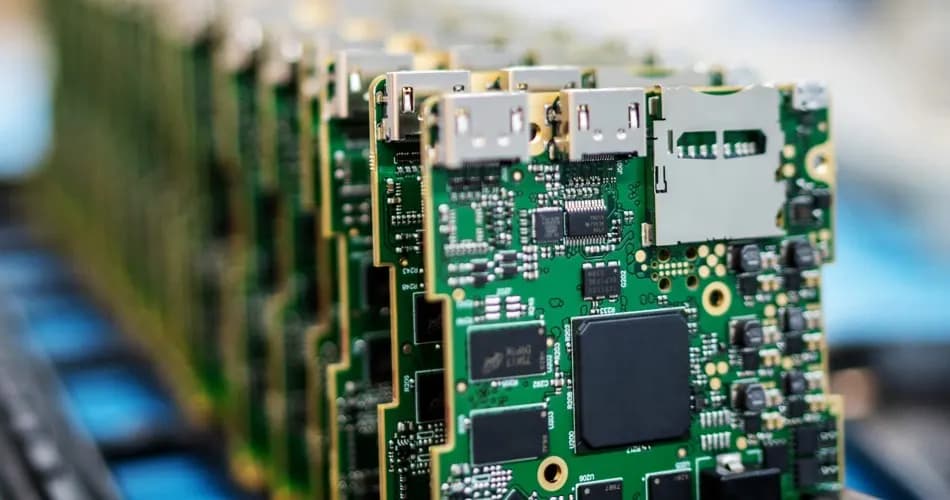
Chefs create recipes. Hardware engineers create BOMs (bills of materials) and SOPs (standard operating procedures). The BOM is the ingredients list for building your product, and the SOP is the set of instructions on how to build it.
What is a bill of materials (BOM)?
A bill of materials (BOM) serves as the foundation for building a product. It is a fundamental set of data that is used throughout the process. A well-constructed BOM clearly communicates all of the technical ingredients required to build the product.
From this information, it is possible to determine:
- The lead time to procure the materials
- Cost of goods sold (COGS)
- Manufacturing processes
- The quality of the design for assembly
- Supply chain robustness
- Cash flow requirements
A bill of materials (also known as a BOM or bill of material) is a comprehensive list of the parts, items, assemblies and other materials required to create a product, along with the instructions required for gathering and using them. All manufacturers, regardless of their industry, start building products by creating a bill of materials.
Because the bill of materials pulls together all sorts of product information, many disciplines (design and engineering, document control, operations, manufacturing, purchasing, contract manufacturers and more) use the data in the BOM record to get the job done right. In fact, engineers and manufacturers rely so heavily on BOMs that they have their own special subsets: the engineering bill of materials (EBOM) and the manufacturing bill of materials (MBOM).
The BOM drives good results in activities such as parts sourcing, outsourcing and manufacturing, so it is important to create a BOM that is well organized, correct and up to date.
What to include in an effective bill of materials
An effective BOM doesn't have to be generated by sophisticated software. It can be as simple as an Excel spreadsheet. BOMs are usually broken up into several categories, which makes it easy for you, your colleagues and your vendors to find what you need. For example, the PCBA (printed circuit board assembly) manufacturer only cares about the PCBs and the components to be surface mounted onto the boards; the packaging components usually don't need to be procured for early prototype builds.
Because one of the main functions of the BOM is to make sure the product is built right, it is best to include specific pieces of product data in the BOM record. Whether you are creating your first bill of materials or looking for ways to improve how you create one, here is a high-level list of information to include:
- BOM level: Assign each part or assembly a number to show where it fits in the hierarchy of the BOM. This allows anyone who understands the BOM structure to decipher it quickly.
- Part number: Assign a part number to each part or assembly so that parts can be referenced and identified quickly. Manufacturers commonly choose either an intelligent or a non-intelligent part numbering scheme. Whichever scheme you use, avoid creating multiple part numbers for the same part.
- Part name: Record the unique name of each part or assembly. This will help you identify parts more easily.
- Phase: Record the stage each part has reached in its lifecycle. For parts in production, it is common to use a term like "In Production". New parts that have not yet been approved can be classified as "Unreleased" or "In Design". This is helpful during new product introduction (NPI) because it allows you to track progress easily and create realistic project timelines.
- Description: Provide a detailed description of each part to help you and others distinguish between similar parts and identify specific parts more easily.
- Quantity: Record the number of parts used in each assembly or subassembly to guide purchasing and manufacturing decisions and activities.
- Unit of measure: Classify the measurement in which a part will be used or purchased. "Each" is common, but standard measures such as inches, feet, ounces and drops are also suitable. Be consistent across similar part types, because this information helps make sure the right quantities are procured and delivered to the production line.
- Procurement type: Document how each part is purchased or made (for example, off-the-shelf or made to specification) to create efficiency in manufacturing, planning and procurement activities.
- Reference designators: If your product contains printed circuit board assemblies (PCBAs), include reference designators in your BOM that show where each part fits on the board. Capturing this information in the BOM can save time and help you avoid confusion down the road.
- BOM notes: Capture other relevant notes to keep everyone who works with your BOM on the same page.
Documenting all of this information in your BOM will keep business activities and manufacturing tasks on target.
BOM example
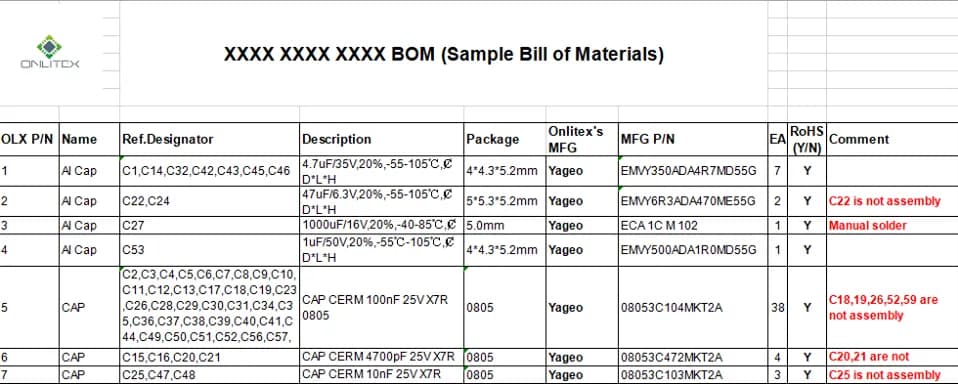
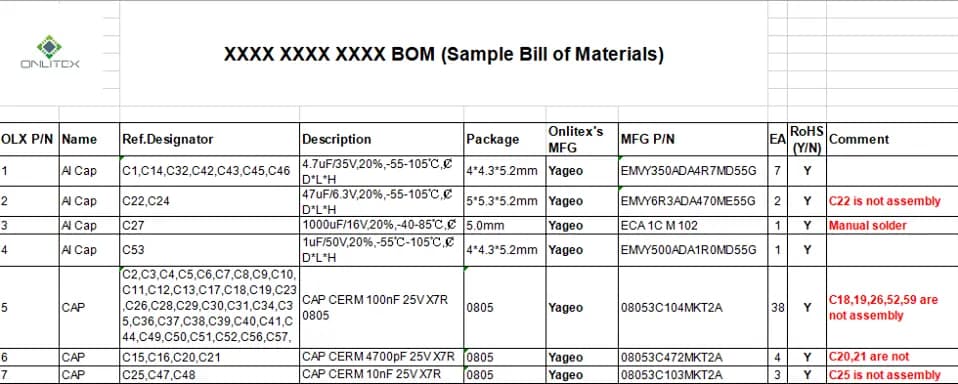
Here is an example of part of a BOM that includes some of the information mentioned above. The sheet is clean, organized and clearly labeled, and information is recorded consistently throughout. This is just an example; your BOM will likely be longer and contain more information.
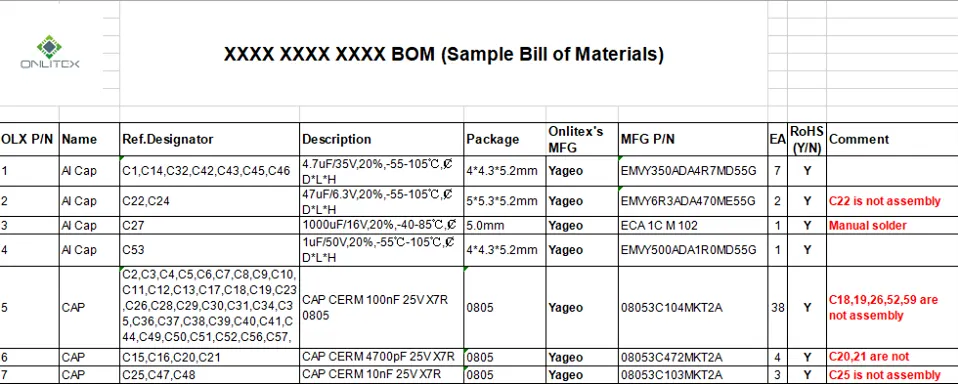
In the far-left column of the bill of materials example above, you'll see the name of the part. Next to that are the designator, the description of the item and the package type, followed by the manufacturer and the part number, and finally the quantity and remarks.
How Onlitex can help
At Onlitex, we focus on quality and provide a full range of PCB services, including procurement, manufacturing and assembly. We use our one-stop approach and a series of useful tools to make your PCB project easy to complete. Contact our knowledgeable support team for assistance at any stage of your project.
- #bill of materials
- #BOM
- #PCB assembly
- #component sourcing