How laser welding works in SMT and PCBA processing, the key parameters (power density, pulse shape, pulse width, defocus and speed) and ways to improve it.
 Onlitex Engineering Team3 min read
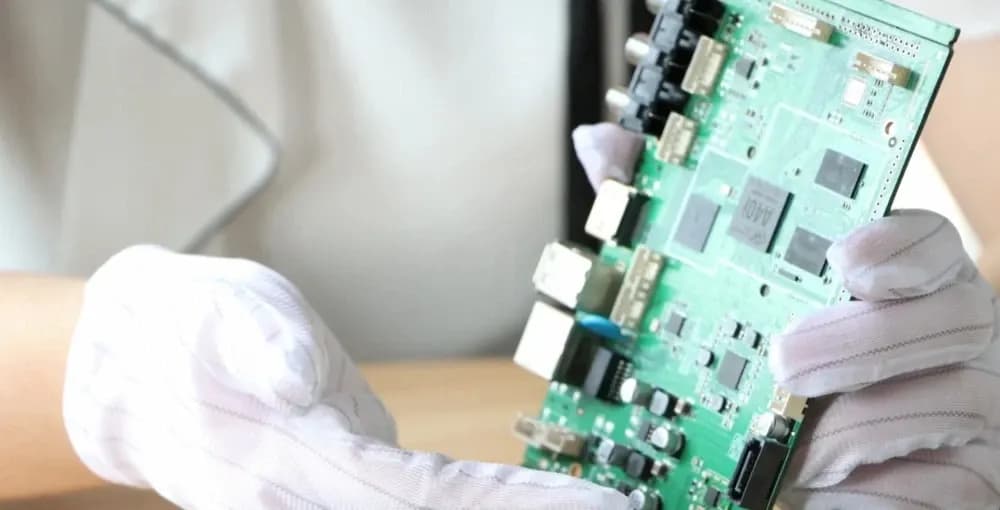
In the aviation industry and many other applications, laser welding can join many types of materials, and it usually has advantages that other fusion welding processes cannot match. In particular, laser welding can join thin alloy sheets that are difficult to weld in the aviation and automotive industries, such as aluminum alloys, with little distortion of the parts and high joint quality.
Another attractive application of laser processing is its ability to heat a very small local area. The laser's hot spot makes it very suitable for soldering electronic devices such as printed circuit boards: the laser can produce a high average temperature in a very small area of an electronic device, while the area outside the joint is essentially unaffected.
1. Principle of laser welding
Laser welding can be performed with a continuous or a pulsed laser beam. It can be divided into heat conduction welding and deep penetration welding:
- When the power density is below 10⁴–10⁵ W/cm², it is heat conduction welding, and welding is slow.
- When the power density is above 10⁵–10⁷ W/cm², the heat pushes the metal surface into a "keyhole", forming deep penetration welding, which is fast and has a high depth-to-width ratio.
In SMT processing, two types of laser are used for welding: CO2 gas lasers and Nd:YAG (neodymium-doped yttrium aluminum garnet) lasers. Laser welding is also used to repair high-density SMT board assemblies, for example to cut redundant printed traces and to repair or add components, without heating the other solder joints, which ensures the quality of the repair.
2. Key process parameters of laser welding
Power density
Power density is one of the most critical parameters in laser processing. In conduction laser welding, the power density generally ranges from 10⁴ to 10⁶ W/cm².
Laser pulse waveform
The laser pulse waveform is an important factor in laser welding, especially for welding thin sheets. When a high-intensity laser beam hits the material surface, 60–98% of the laser energy is reflected and lost from the metal surface, and the reflectivity changes with the surface temperature. During a single laser pulse, the reflectivity of the metal changes greatly.
Laser pulse width
Pulse width is one of the important parameters of pulsed laser welding. It not only distinguishes material removal from material melting, but is also a key parameter that determines the cost and size of the processing equipment.
Defocus amount
Laser welding usually needs a certain amount of defocus, because the power density at the center of the spot at the laser focus is too high and easily vaporizes the material into holes. There are two defocus modes: positive and negative. When the focal plane is above the workpiece, it is positive defocus; when it is below, it is negative defocus. In practice, negative defocus is used when a large penetration depth is required, and positive defocus should be used when welding thin materials.
Welding speed
Welding speed affects the heat input per unit time. If the welding speed is too slow, the heat input is too high and the workpiece may burn through. If it is too fast, the heat input is too low and the weld may be incomplete.
3. Ways to enhance laser welding
To eliminate or reduce laser welding defects and make better use of this excellent welding method, several hybrid processes have been proposed that combine lasers with other heat sources. These mainly include laser and arc, laser and plasma arc, and laser and induction heat source hybrid welding, as well as dual-beam and multi-beam laser welding.
Various auxiliary process measures have also been proposed, such as laser welding with filler wire (cold wire or hot wire welding), laser welding enhanced by an external magnetic field, laser welding with controlled shielding gas, and laser-assisted friction stir welding.
If you need to know more about PCB prototyping, SMT mounting or PCBA processing, contact us.
- #laser welding
- #laser soldering
- #SMT processing
- #PCBA repair